
Published 16/11/2026 · 6 min read
Workplace vending has evolved far beyond the unreliable coin-operated metal boxes of past decades. Across Australian warehouses, manufacturing plants, corporate headquarters, and healthcare facilities, modern automated retail systems now provide staff with chilled drinks, fresh food, barista-quality coffee, and healthy snacks around the clock. Yet for many office managers, operations directors, and human resources teams, the operational mechanics behind vending machines remain unfamiliar territory.
This guide explains the fundamentals of workplace vending in Australia: who supplies and manages the hardware, what duties fall on the host site, why businesses invest in on-site automated retail, and how the end-to-end installation process works from initial inquiry to the first transaction.
Who Supplies, Owns, and Services the Machines?
One of the most common misconceptions about commercial vending is that a business must buy an expensive machine outright and assign an employee to visit wholesalers, unpack boxes, and count cash. In the modern Australian vending sector, that model is largely obsolete.
The Full-Service Operator Model
In the vast majority of commercial settings, equipment is provided under a fully managed, full-service arrangement often referred to as free-hire or machine placement. Under this model, a specialist vending provider such as Vending Machines Australia supplies the machine, retains ownership of the asset, and takes full responsibility for its operation.
The operator handles:
- Capital outlay for the commercial-grade machine, refrigeration unit, and digital payment terminal.
- Transport, specialized positioning, and initial commissioning on site.
- Regular restocking with tailored product selections based on consumption data.
- Preventative maintenance, component repairs, sanitisation, and routine software updates.
- Payment processing, merchant facilities, and cashless network connectivity via internal 4G telemetry.
The Host Site's Role
Because the vending operator absorbs the financial risk and operational legwork, the relationship functions as a commercial partnership. In exchange for providing high-end amenities to employees, the host business provides the physical footprint, the electrical supply, and reliable physical access for the operator's service technicians and route merchandisers.
What Is the Host Site Responsible For?
While a full-service placement eliminates daily administration for your facilities team, a vending machine is a heavy, powered commercial appliance. To ensure safe, compliant operation, host sites must satisfy a few clear physical and logistical prerequisites.
1. Electrical Supply and Utilities
Standard Australian commercial refrigerated vending machines typically run on a standard single-phase 240V alternating current circuit. The site must provide a dedicated 10-amp General Purpose Outlet (GPO) located within 1.5 metres of the machine footprint. Trailing extension cords across staff walkways violate Australian workplace health and safety (WHS) standards and are not permitted by reputable operators. Modern energy-efficient vending machines draw minimal continuous power, typically consuming between 2.5 and 4.5 kilowatt-hours per day, costing the site only a modest amount in electricity each month.
2. Physical Dimensions and Floor Capacity
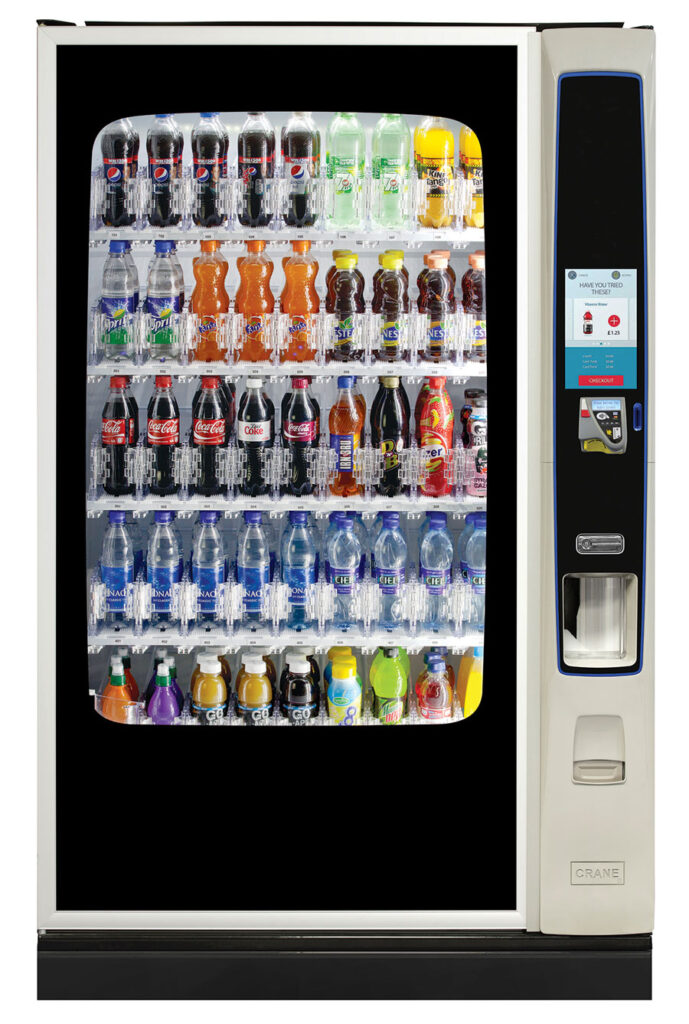
A standard combination drink-and-snack vending machine measures roughly 1830 mm high, 900 to 1100 mm wide, and 850 mm deep. When fully loaded with chilled cans, bottles, and food, an industrial glass-front vendor can weigh between 350 kg and 450 kg. The designated surface must be structurally sound, flat, and completely level. Furthermore, machines require roughly 100 mm of clearance at the rear and sides to maintain continuous airflow across the refrigeration condenser.
3. Environmental Protection
Commercial vending equipment must be situated indoors or within a fully weather-protected alcove. Direct exposure to Australian rain, high humidity, or intense afternoon sun can degrade sensitive electronic mainboards, cause glass refrigeration panels to sweat with condensation, and cause internal compressors to overheat prematurely.
4. Site Access for Merchandisers
Vending operators rely on scheduled route drivers to keep shelves stocked and coin/cashless systems balanced. The host site must provide frictionless, safe access for the restocking team during agreed operating hours, including clear access to loading docks, service lifts, and secure security-badged entry points.
Why Employers Install Workplace Vending
Businesses choose to add automated food and beverage services for several operational, commercial, and cultural reasons. Rather than acting merely as an indulgence, an on-site vendor solves measurable friction points in day-to-day operations.
Eliminating Break-Time Leakage
Under Australian industrial awards and workplace agreements, staff are allocated strict 15-minute rest breaks and 30-to-60-minute meal periods. When a facility lacks immediate food and drink options, employees often jump in their vehicles to visit the nearest service station, supermarket, or takeaway shop. A routine 15-minute morning tea break frequently stretches into 25 minutes of lost production while staff sit in local traffic or queue at retail registers. Providing on-site food and drinks keeps teams on premises, preserves scheduled rosters, and eliminates off-site travel stress.
Sustaining 24/7 Shifts and Remote Operations
For distribution centres, manufacturing facilities, logistics hubs, and hospitals operating on afternoon, night, or weekend shifts, nearby retail food businesses are usually closed. Shift workers frequently face limited options: packing cold meals from home or relying on fast-food drive-throughs. Automated vending delivers fresh ready-meals, energy drinks, protein bars, and hot coffee at 2:00 AM on a Sunday just as easily as at midday on a Tuesday.
Staff Morale and Retention
Access to refreshing beverages, hydration, and wholesome snacks contributes directly to day-to-day workplace satisfaction. Forward-thinking employers often coordinate with their operator to include healthier alternatives—such as cold-pressed juices, low-sugar drinks, protein options, and gluten-free snacks—supporting corporate wellness initiatives without administrative overhead.
How a Placement Works: Step by Step
Securing a professionally managed vending service follows a predictable, structured installation pathway designed to avoid workplace disruption.
Step 1: Initial Qualification and Needs Analysis
The process starts with evaluating the workplace profile. Vending operators typically assess total site headcount, operational hours (single shift vs 24/7), proximity to local commercial shops, and staff demographics. A standalone facility with 50 to 100 on-site workers generally produces the baseline daily volume necessary to sustain a dedicated, fully managed machine.
Step 2: Site Audit and Access Survey
Before moving any hardware, the logistics team conducts a site audit. This step verifies doorway widths, hallway clearances, lift weight limits, stairs, and floor levelness along the delivery path. Because industrial vending units do not fit through narrow domestic doorways, measuring entry thresholds ensures smooth, incident-free delivery.
Step 3: Product Planogram Customisation
The operator works with your site coordinator to establish the initial product selection (the planogram). Choices can balance traditional treats (carbonated soft drinks, chips, chocolates) with functional choices (electrolyte drinks, cold coffees, nuts, muesli bars, and ready-to-heat snacks). Over time, this mix is dynamically refined based on telemetry sales data.
Step 4: Professional Delivery and Commissioning
Specialist commercial machinery movers transport the machine using tail-lift vehicles and stair-climbing stairwalkers where required. Once rolled into position, the unit is levelled using adjustable feet to ensure correct gravity feeding on dispensing trays. The technician connects the unit to the dedicated 10A GPO, configures internal refrigeration target temperatures, powers up the LED illumination, and activates the cashless card reader.
Step 5: Live Telemetry and Restocking
Every modern machine is linked to cloud management software via an integrated 4G telemetry modem. When an employee taps their card to buy a bottle of water, the transaction is registered on the operator's central dashboard in real time. The operator does not need to guess when stock is low; the management system schedules restock visits automatically whenever inventory drops below predetermined thresholds.
Cashless Convenience and Transparent Support
Today, cash accounts for less than 10 percent of everyday Australian vending transactions. Modern units feature certified tap-and-go contactless terminals supporting Visa, Mastercard, Apple Pay, Google Pay, and wearable devices. These terminals process transactions within seconds, minimising queue times during peak shift-changeover windows.
When unexpected faults occur—such as an uncooperative product coil or a drop sensor error—a professional operator provides visible service decals with direct telephone and digital support details. Responsive service agreements ensure qualified repair technicians attend the site promptly, keeping machine uptime near 100 percent without your facilities staff having to lift a finger.
Frequently asked questions
How much does a fully managed workplace vending machine cost our business?
Under a standard full-service placement model, there is typically zero capital cost or ongoing rental fee for the host business. The vending supplier provides, delivers, stocks, and maintains the machine entirely at their own expense, recouping their operational investment directly through product sales via the on-board cashless payment terminal.
What power connection does an on-site vending machine require?
Most commercial refrigerated glass-front vending machines run on a standard Australian 240V single-phase electrical supply. Your site simply needs to provide a standard, dedicated 10-amp power outlet (GPO) within approximately 1.5 metres of the machine location. Extension cords should not be used across workplace walkways.
What is the minimum staff headcount required to qualify for a free machine?
To ensure products remain fresh and turn over consistently, operators typically look for a minimum of 40 to 50 full-time staff on site for standard commercial locations. Sites with 24/7 shifts, manufacturing environments, or isolated industrial locations may qualify with slightly smaller numbers due to higher on-site consumption.
How does the machine communicate when stock runs low?
Modern workplace vending machines are equipped with internal 4G telemetry modems. Every transaction is tracked in real time via automated cloud-based inventory software. When stock levels reach predetermined thresholds, your operator's route management system automatically schedules a restock run without your staff needing to call.
Want a machine at your site?
Free placement for eligible sites, or new and refurbished machines to buy, lease or finance. We reply within 8 business hours.
Make an enquiry