
Published 21/11/2026 · 7 min read
Installing an on-site vending machine delivers immediate convenience for staff, contractors, and visitors, but successful deployment requires careful operational planning. A vending machine is not simply a piece of office furniture; it is an active commercial refrigeration appliance with specific footprint, electrical, connectivity, and restocking demands.
Site managers, facilities coordinators, and operations supervisors can avoid costly relocations, tripped circuits, and service delays by auditing their premises beforehand. This checklist details the essential operational criteria required to qualify a site before engaging a vending supplier.
1. Headcount and Foot Traffic Volume
Before measuring doorways or allocating power, evaluate whether your site generates sufficient daily demand to sustain a machine. Vending operators typically rely on turnover volume to cover equipment depreciation, restocking labour, and inventory holding costs.
- **Static Headcount:** A single-shift commercial office or warehouse generally requires a minimum of 40 to 50 full-time equivalent (FTE) staff on site each day to sustain a combined drink and snack machine. Highly automated distribution centres or low-density manufacturing sites may need higher total staff counts to generate equivalent retail volume.
- **Shift Structures:** Facilities operating across two or three shifts, such as logistics hubs, call centres, or manufacturing plants, often support machines with lower baseline headcounts because night and weekend shifts lack external food options.
- **Transient Traffic:** If your facility hosts regular external foot traffic, such as client waiting rooms, sporting facilities, or driver rest areas, factor these daily visitors into your baseline traffic estimation.
2. Break Schedules and Movement Patterns
The physical location of your machine should align with staff movement patterns and scheduled breaks to prevent corridor bottlenecks.
- **Concentrated vs Staggered Breaks:** If 100 workers take lunch simultaneously, a single machine can create queue congestion. Evaluate whether break times are staggered or if multiple smaller machines across separate tearooms are preferable.
- **Travel Distance:** If a worker must walk four minutes each way during a standard 15-minute rest break, they will avoid using the amenity. Place machines in central lunchrooms, main transit spines, or directly adjacent to outdoor breakout zones.
- **Congestion Points:** Never position a vending machine directly beside pinch points, fire exit doors, emergency eyewash stations, or electrical distribution boards.
3. Floor Space, Clearances, and Delivery Path
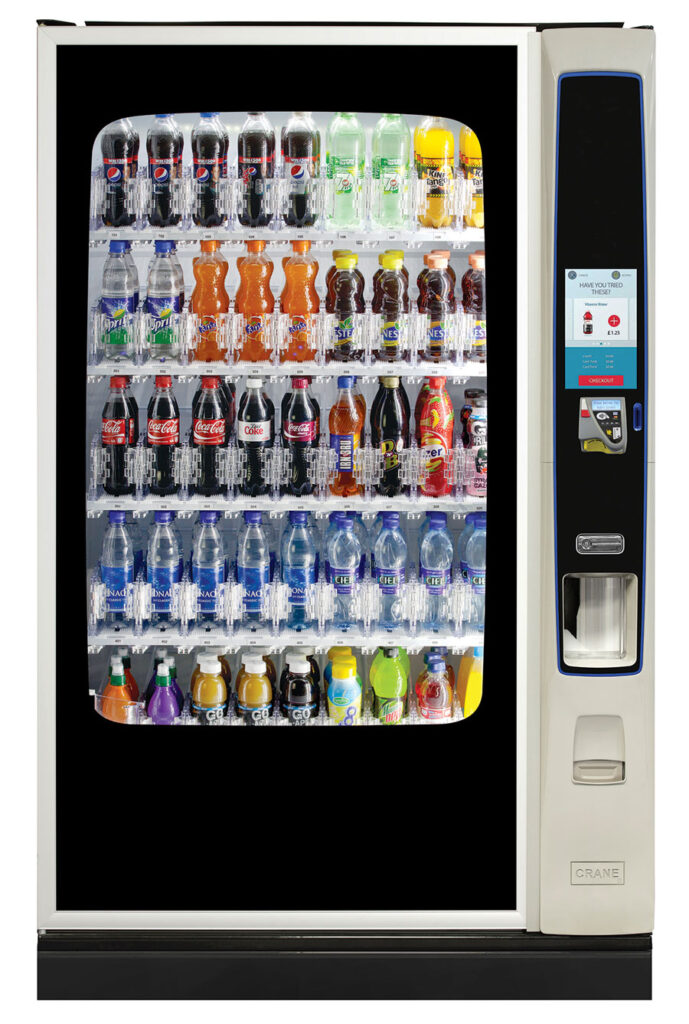
Vending machines are heavy, bulky assets. A standard commercial combination glass-front machine weighs between 300 kg and 450 kg empty, increasing to 550 kg when fully stocked with canned drinks and bottled water.
- **Footprint Dimensions:** An average modern combination machine measures approximately 900 mm to 1100 mm in width, 800 mm to 950 mm in depth, and 1830 mm in height. Allocate a working footprint of at least 1200 mm wide by 1000 mm deep.
- **Door Swing Allowance:** Glass-front merchandisers swing open forward by up to 900 mm for maintenance and refilling. Ensure there is ample space in front of the unit so restocking trolleys do not block primary fire evacuation paths or general pedestrian flow.
- **Ventilation and Heat Dissipation:** Commercial refrigeration units extract heat constantly. The machine requires at least 100 mm of clear space behind the rear grille and 50 mm along the sides to allow adequate airflow. Enclosing a machine in a tight, unventilated joinery alcove causes compressor burnout and voids equipment warranties.
- **Delivery Access Pathway:** Verify the complete transit path from the delivery vehicle dock to the final location. Check lift dimensions, staircases, ramp gradients, and internal doorway clearances. Standard internal commercial doors are often 820 mm wide; if the machine depth is 850 mm, the door stops or external trim may need temporary removal during install.
4. Electrical Supply and Safety Requirements
Modern vending machines use energy-efficient LED lighting and variable-speed refrigeration compressors, but their electrical supply must still meet strict commercial standards.
- **Dedicated Power Point:** A standard Australian 240V, 10-amp general purpose outlet (GPO) is required. The outlet should be located within 1.0 to 1.5 metres of the machine, preferably positioned high on the wall or directly beside the unit rather than directly behind it, so power can be isolated quickly in an emergency.
- **Circuit Capacity:** Avoid daisy-chaining the machine onto the same circuit as heavy-draw kitchen equipment, such as microwaves, boiling water units (e.g. Zip taps), or commercial dishwashers. Starting current from compressor cycling can trip shared residual current devices (RCDs).
- **Extension Cords:** Commercial vending machines must never be run from domestic multi-boards or flexible extension leads across open floors. This creates a severe trip hazard, violates workplace health and safety (WHS) regulations, and risks voltage drop to the refrigeration motor.
- **Testing and Tagging:** Ensure the equipment is tagged to AS/NZS 3760 standards upon installation, and add the machine to your annual site compliance register.
5. Telemetry and Cashless Payment Connectivity
Cash transactions have largely been replaced by contactless card, smartphone, and wearable payments. In Australia, cashless transactions account for over 85 to 90 percent of workplace vending turnover.
- **Cellular Signal Strength:** Cashless card readers (such as Nayax or Cantaloupe systems) rely on internal 4G or 5G telemetry modems to authorise payments and report stock levels. Test the mobile data signal at the proposed installation spot using standard Telstra and Optus networks. Basement levels, underground car parks, and reinforced-concrete industrial units frequently exhibit dead zones that require an external high-gain antenna.
- **Wi-Fi Alternatives:** If cellular signal is obstructed, establish whether your corporate IT policy permits the vending modem to access a guest Wi-Fi network without complex enterprise-grade captive portals.
6. Security, Lighting, and After-Hours Access
Equipment safety and user comfort are critical, particularly in 24/7 industrial or logistics settings.
- **Lighting and Visibility:** Place the machine in a brightly lit common area. Adequate illumination deters tampering and provides staff with a safe environment during night shifts.
- **CCTV Coverage:** While internal workplace machines face lower vandalism risks than public transit sites, position the unit within line-of-sight of existing security cameras to discourage physical rocking, forced door attempts, or inventory theft.
- **Restocker Access:** Suppliers must be able to park securely, wheel heavy stock trollies into the premises, and access the machine during normal business hours. If your site requires security inductions, sign-in procedures, or escorting, confirm these logistics prior to agreement.
7. Product Mix Strategy
Align the stock holding with the specific demographic and operating tempo of your workplace.
- **Trade and Logistics Sites:** Industrial work environments generally demand high-caffeine energy drinks, 600 ml flavoured milks, isotonic sports drinks, and substantial snack items such as beef jerky, nuts, and protein bars.
- **Corporate and White-Collar Offices:** Professional service firms frequently favour sparkling water, no-sugar sodas, kombucha, cold-brew coffees, and portion-controlled healthy snacks.
- **Fresh Food Considerations:** If requesting fresh meals (such as wraps, salads, or ready meals), discuss shelf-life management with your operator. Fresh items carry tight use-by windows and require precise cold-chain tracking to maintain food safety.
8. Waste and Pest Management
Introducing high-turnover food and beverage packaging into a workspace requires dedicated waste handling.
- **Bin Placement:** Position high-capacity general waste and co-mingled recycling bins directly beside the machine to keep lunchrooms tidy.
- **Pest Control:** Spilled sugary sodas, unrinsed cans, and food crumbs attract ants and rodents. Integrate the vending alcove into your contract cleaners' daily wipe-down schedule, and confirm that pest management contractors treat around and beneath the unit during routine visits.
9. Key Questions to Ask Prospective Suppliers
Before signing a supply contract or placement agreement, ask the vending operator the following operational questions:
- What is your guaranteed restocking frequency, and do your machines use live telemetry to trigger dynamic restocks when items run low?
- What is your contractually agreed response time for physical hardware breakdowns and refrigeration cooling failures?
- How do you handle refund management when an item fails to drop or a tap payment is incorrectly charged?
- Are your machines equipped with optical drop sensors (guaranteed delivery systems) to eliminate paid-for item hangs?
- Do you carry public and products liability insurance of at least $20 million, and can you supply a certificate of currency noting our company as an interested party?
- What are the exit terms if daily turnover does not meet minimum operating thresholds for both parties?
Frequently asked questions
What electrical outlet does a standard commercial vending machine require in Australia?
A standard commercial vending machine in Australia requires a dedicated, single-phase 240V, 10-amp general purpose outlet (GPO). The outlet should be located within 1.5 metres of the unit and protected by a residual current device (RCD). Extension leads or domestic power boards should never be used, as they violate workplace safety standards and risk voltage drop.
How much clearance does a vending machine need behind it?
A vending machine requires a minimum clearance of 100 mm behind the rear condenser grille and at least 50 mm on both sides. This space allows the refrigeration unit to exhaust hot air effectively. Confining a machine inside an unventilated or tightly fitted alcove restricts airflow, leading to higher power consumption, component overheating, and premature compressor failure.
What is the minimum workplace headcount needed for a vending machine?
Most commercial vending machine operators look for a baseline of roughly 40 to 50 full-time staff on site during standard business hours. For multi-shift facilities, such as 24-hour distribution centres or manufacturing plants, a lower staff headcount of 25 to 35 workers across shifts can often justify a combination snack and cold drink machine.
Why is mobile cellular coverage important for modern vending machines?
Modern vending machines rely on cashless payment terminals and remote telemetry units that communicate over 4G or 5G mobile networks. If cellular signal is blocked by concrete walls or underground basements, customers cannot complete card or phone transactions, and the operator cannot track live stock levels, requiring external antennas or network adjustments.
Want a machine at your site?
Free placement for eligible sites, or new and refurbished machines to buy, lease or finance. We reply within 8 business hours.
Make an enquiry