
Published 21/10/2026 · 7 min read
Free Vending Machines for Industrial and Manufacturing Sites
A free vending machine service provides industrial workplaces with commercial-grade food, drink, or safety vending equipment at zero capital expenditure. Under this fully managed arrangement, Vending Machines Australia supplies, installs, maintains, and restocks the machine without charging hire fees or service retainers to the site host. Operating revenue is generated solely through user transactions, making it an accessible amenity for operational facilities seeking to improve workplace convenience.
Factories, logistics warehouses, fabrication plants, and trade workshops operate under vastly different conditions than standard corporate offices. Floor staff undertake physical labour across long shifts, often in warm conditions, with scheduled breaks that do not allow time to travel offsite. Providing reliable access to cold drinks, calorie-dense meals, snacks, and personal protective equipment (PPE) inside the facility supports workplace safety, maintains shift momentum, and reduces unnecessary downtime.
The Industrial Challenge: Shift Work and Remote Estates
Most modern Australian distribution centres and industrial facilities are positioned in dedicated manufacturing corridors or logistics hubs on the urban fringe—such as Western Sydney, Dandenong South, or outer Brisbane. While these locations offer the arterial road access required for freight, they are frequently retail deserts.
For staff on-site, obtaining refreshments during a shift presents practical hurdles:
- **No Local Amenities:** The nearest service station, takeaway shop, or supermarket is often a ten- to fifteen-minute drive away.
- **Night and Weekend Shifts:** Commercial food outlets typically close by early evening, leaving night-shift pickers, forklift operators, and maintenance crews with zero external dining options.
- **Short Break Windows:** Enterprise agreements and award structures generally allocate standard 30-minute unpaid meal breaks and 10-to-15-minute paid rest breaks. If a worker leaves the site to purchase lunch or a beverage, travel and queue times consume the majority of the break.
Placing an automated retail solution directly in the central break room or warehouse floor resolves these logistical gaps, ensuring that clean, temperature-controlled refreshments are available 24 hours a day, seven days a week.
The Productivity Case for Keeping Staff On-Site
When workers leave an industrial site during their breaks, businesses experience measurable friction. Beyond the obvious risk of late returns due to traffic congestion, offsite travel increases site vehicle movements, introduces perimeter gate delays, and disrupts team continuity.
Consider an industrial workshop running two ten-hour shifts with forty staff. If ten workers leave the premises each day to buy an energy drink, hot snack, or sandwich, that equates to ten vehicle movements through the main gate, associated parking congestion, and a recurring risk of production lines starting late after lunch.
By contrast, keeping staff comfortably on-site during allocated breaks yields tangible operational gains:
- **Shift Continuity:** Workers take their breaks promptly in the dedicated lunchroom and return to assembly lines or picking aisles on the exact minute.
- **Reduced Fatigue and Incident Risk:** Rushing to an offsite convenience store during a short break introduces road risk and stress. On-site vending allows employees to rest, hydrate, and recharge within a controlled environment.
- **Improved Morale and Retention:** Shift workers, particularly those working irregular night hours, frequently report feeling neglected compared to daytime office staff. A well-stocked, clean vending machine stocked with premium brands demonstrates tangible consideration for their working conditions.
Machine Configurations for Industrial Workplaces
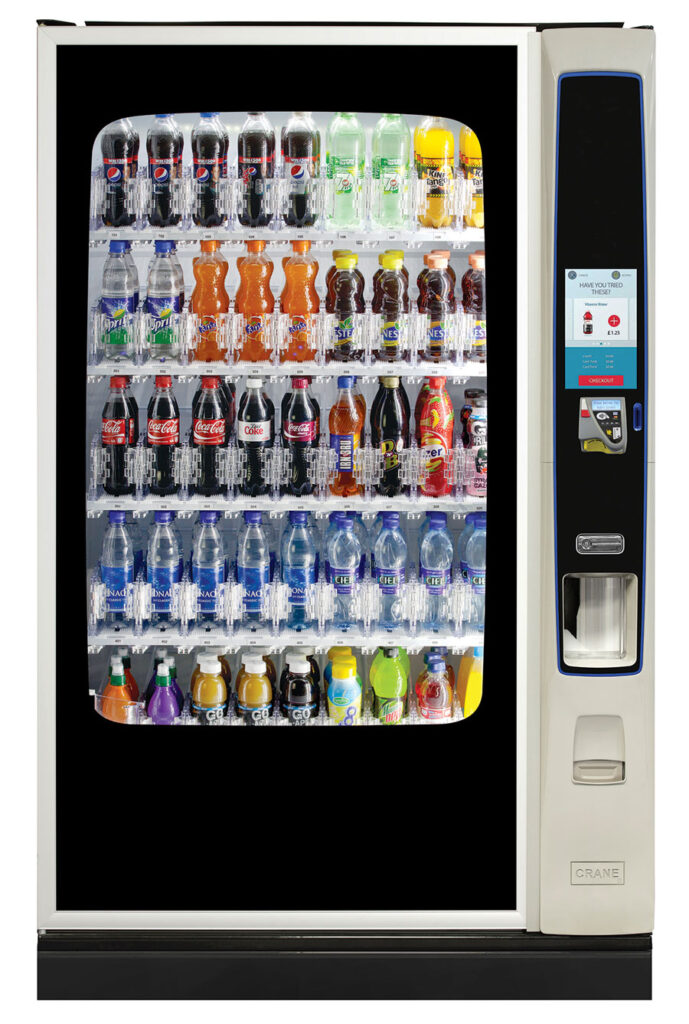
Industrial environments demand distinct product mixes compared to commercial office suites. A standard office machine heavy on confectionery and mineral water will underperform in an engineering workshop where workers need heavy hydration and sustained energy.
Drinks-Heavy and High-Hydration Machines
Physical labour rapidly accelerates dehydration, especially inside uninsulated metal-clad warehouses during Australian summers. Drink-dominant configurations are the most requested option for industrial facilities. These units feature high-capacity refrigeration compartments configured to hold:
- Electrolyte replenishment drinks and sports drinks
- Bottled spring water and sparkling water
- Ready-to-drink iced coffees and protein shakes
- Energy drinks and chilled juices
- Traditional soft drinks in cans and bottles
Combination Snack and Meal Units
Where break rooms have limited footprint, combination machines house both chilled drinks and pantry items behind a single refrigerated glass facade. Top shelves feature snacks, chips, protein bars, meat sticks, and confectionery, while lower chilled sections can accommodate microwaveable meals, instant noodles, and chilled dairy items suitable for a fast, substantial meal.
PPE and Safety Consumable Vending
Beyond food and beverages, industrial sites frequently deploy modified spiral or locker vending machines to manage personal protective equipment. PPE machines dispense safety glasses, high-abrasion gloves, earplugs, respiratory dust masks, and cut-resistant sleeves. These units can operate on standard cashless tap-and-pay for subcontracted trades, or integrate with staff RFID swipe cards to track departmental safety usage and prevent inventory shrinkage.
Environmental Durability: Dust, Heat, and Ruggedness
Commercial vending equipment designed exclusively for air-conditioned office lobbies will fail quickly in a busy fabrication workshop or freight terminal. Industrial sites introduce environmental factors that require specialised consideration.
Dust and Particulate Management
Timber processing, metal fabrication, and high-traffic warehousing generate airborne saw dust, grinding swarf, and concrete dust. When cooling fans pull this airborne matter into standard refrigeration condenser coils, the coils clog, causing compressors to overheat and fail. Industrial-grade vending machines feature shielded electronic control boards, heavy-duty condenser fan motors, and accessible air filtration screens that can be regularly cleaned during routine servicing.
Ambient Heat Ratings
Warehouses across Queensland, Western Australia, and regional New South Wales often experience indoor summer ambient temperatures exceeding 38 degrees Celsius. Machines deployed in these sites must utilise commercial refrigeration units charged with modern refrigerants, insulated polyurethane foaming, and double- or triple-glazed heated front glass to prevent external condensation from obscuring product visibility.
Structural Ruggedness
Warehouses are busy environments with pallet jacks, hand trolleys, and heavy steel-capped work boots. Machines installed in lunchrooms adjacent to active workshops must feature anti-vandal steel casings, secure lock housings, impact-resistant polycarbonate or toughened glass frontages, and recessed payment readers capable of withstanding rough everyday use.
Site Installation and Technical Requirements
Installing a modern vending machine requires minimal infrastructure. Facilities need only prepare a clear, accessible position with the following baseline specifications:
- **Electrical Connection:** A standard single-phase 240V, 10-amp grounded power outlet located within 1.5 metres of the machine. Dedicated circuits are preferred to avoid tripping from nearby heavy equipment.
- **Footprint and Clearance:** A standard combination or drink machine requires a floor footprint roughly 900mm to 1200mm wide and 850mm to 950mm deep, with at least 100mm of rear clearance to maintain adequate condenser ventilation.
- **Floor Stability:** Concrete slab flooring capable of safely supporting 350kg to 450kg of static machine weight when fully loaded with beverages.
- **Telecommunications:** Contemporary machines utilize integrated 4G telemetry modems for processing tap-and-go card payments and transmitting real-time stock levels. The site requires reasonable mobile reception; internal company Wi-Fi is generally not required.
Telemetry Monitoring and Restocking Protocols
Modern vending logistics eliminate the historical problem of empty shelves and expired products. Each unit supplied by Vending Machines Australia features cloud-connected telemetry hardware.
This technology monitors every sale in real time. Route managers track stock depletion remotely, allowing restocking cycles to be scheduled dynamically based on consumption rather than arbitrary timetables. During a sudden heatwave where bottled water and sports drink consumption triples, the automated monitoring system alerts route drivers to dispatch extra stock before selections run empty.
Payment hardware on all machines accepts standard credit cards, debit cards, mobile phone wallets (Apple Pay, Google Pay), and wearable devices, eliminating the mechanical jams, cash handling risks, and security issues historically associated with coin-only equipment.
Securing a Machine for Your Facility
Equipping a workshop or warehouse with modern vending machinery requires no capital expenditure, long-term leasing commitments, or administrative overhead for your management team. Vending Machines Australia (ABN 30 133 496 885) assesses your workplace headcount, shift patterns, and floor layout to recommend the most practical machine type, handles installation logistics, and manages all ongoing cleaning, refilling, and maintenance.
To discuss site suitability or request a machine placement for your warehouse, contact Vending Machines Australia on 0412 025 552.
Frequently asked questions
How can a vending machine be provided for free to our warehouse?
Under the full-service placement model, the supplier provides, installs, insures, maintains, and restocks the vending machine at no cost to your business. The operator recovers equipment and operational costs entirely through the day-to-day sale of snacks, drinks, or retail items directly to your staff and visitors.
What minimum staff numbers are required for an industrial vending machine?
Most industrial operators look for a site with at least 25 to 30 full-time staff members or equivalent shift workers. Sites with 24-hour operations, multi-shift rosters, or visiting transport contractors often qualify with lower permanent headcounts due to higher daily foot traffic.
Can the vending machine handle dusty warehouse conditions?
Yes. Commercial vending machines designed for industrial placement feature sealed electrical components, durable metal cabinetry, and robust refrigeration systems. Service technicians inspect and clean condenser filters during scheduled restocking visits to keep dust and workshop debris from impacting cooling performance.
What power connection does a workshop need to install a vending machine?
A standard, single-phase 240-volt, 10-amp wall outlet is all that is required. The machine should be positioned on a flat concrete floor within 1.5 metres of the socket, leaving roughly 100 millimetres of rear wall space for clean ventilation airflow.
Want a machine at your site?
Free placement for eligible sites, or new and refurbished machines to buy, lease or finance. We reply within 8 business hours.
Make an enquiry